Scope
Through this project, we wanted to show the potential of AI deep learning models in Manufacturing industry/Materials Science. We have created a demo based on the article Machine learning recommends affordable new Ti alloy with bone-like modulus.
Article summary
Abstract
Artificial neural network (called βLow approach) for designing affordable new Ti alloys with bone-like moduli.
ML Model (see Materials and methods section in the article)
- Two Artificial Neural Networks (ANNs) to predict (1) martensitic transformation start temperature (Ms temperature), (2) Young’s modulus (E) of the beta phase, separately.
- The architecture of the two ANNs should follow the paper’s instruction.
- The final model for E was designed as a 6-8-8-1 neural network. The final model for Ms temperature was designed as a 6-11-6-1 neural network.
Training Data
Two datasets: i) alloy composition and its E and ii) alloy composition and its Ms. The data of E measured by tensile tests were used. 80% data for training, 20% data for validation for both data sets. The training of E and Ms were done independently.
Input Data and Prediction
- Input: alloy element Ti, Nb, Zr, Sn, Mo, Ta, contents in weight percent (wt.%).
- Prediction: Young’s modulus (E) and martensitic transformation start temperature (Ms temperature)
Predictions by two well trained ANNs
Constrains: Ti content ([Ti]) ≥ 40 wt.%,the contents of other elements ≤ 40 wt.%, step size=1 wt.%.
Filters after getting the predictions and corresponding composition:
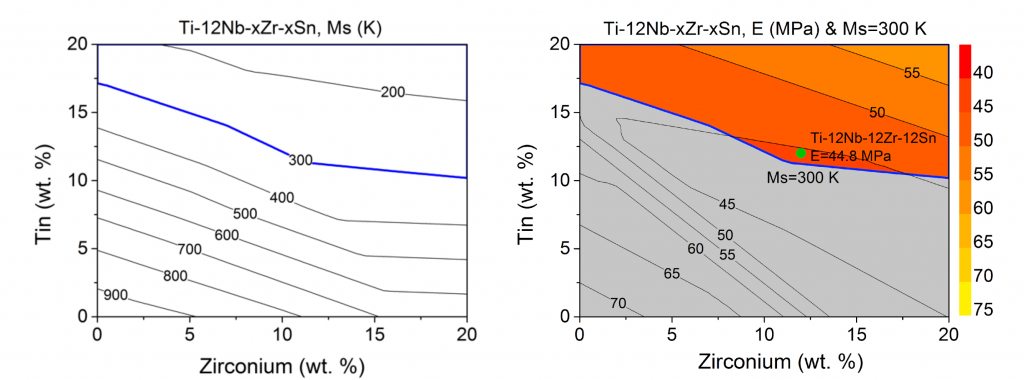
- Filter 1: content [Nb] + [Mo] + [Ta] < 20 wt. %,0 < Ms < 300 K, 0 < E < 50 GPa
- Filter 2: [Ti] > 40 wt.%, [Nb] =12 wt.%, [Sn] < 20 wt.%, [Zr] < 20 wt.%
- Filter 3: [Ti] > 40 wt.%, [Nb] =14 wt.%, [Sn] < 20 wt.%, [Zr] < 20 wt.%
- Filter 4: [Ti] > 40 wt.%, [Sn] < 20 wt.%, [Zr] < 20 wt.%,[Nb] + [Mo] + [Ta] = (100-[Ti]-[Sn]-[Zr]) wt.%
The performance of the well trained neural networks
The network predictions were measured by root-mean-square error (RMSE). The RMSE of well trained network E and Ms on validation data is 7.49 GPa and 32.34 K, respectively, which indicates that the predictions are very good, even better than the corresponding results in the paper.
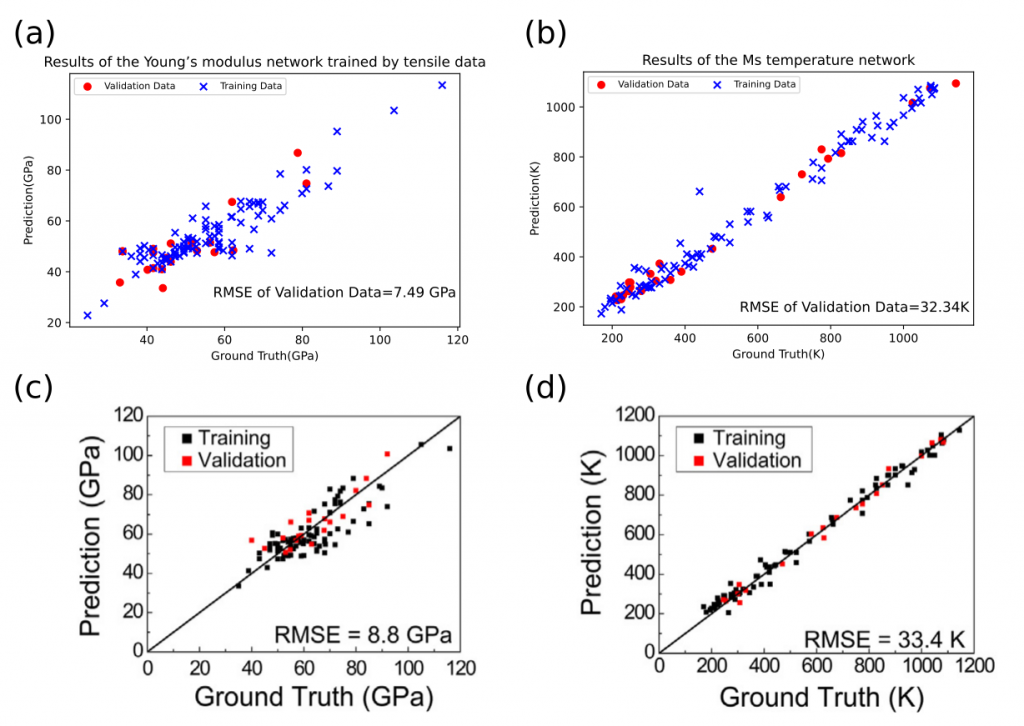
Plot of Prediction vs. Ground truth of Young’s modulus (c) and Ms (d) networks in the reference paper.
Conclusion
The ML models have successfully predicted some new Ti alloys, e.g., Ti-12Nb-12Zr-12Sn (wt.%), which are unexpected by conventional predictive methods. Their predicted Young’s moduli and Ms are proved by the experimental results in the reference paper. The predicted Young’s moduli are close to that of human bone. This new paradigm demonstrates high efficiency and accuracy of finding new alloys with limited resources and time compared to conventional methods. The application of neural network models can be extended to the martensitic transformation in other alloys.